

Deconstructing Birth: How an Indie Game Turned Loneliness into a Cosy Puzzle Experience

Some games entertain you; some challenge you; and then some games quietly sit beside you and make you feel understood.
Birth is one of those games.

At first glance, Birth feels strange. You collect bones and organs across a hand-drawn city to build yourself a companion. The world is filled with skeletal creatures, preserved specimens, odd little machines, and environments that blur the line between unsettling and comforting.
But the brilliance of Birth lies in how it transforms themes that are usually associated with horror, death, decay, isolation, and body parts into something deeply tender. The game is not really about building a creature. It is about loneliness. And more importantly, it is about the quiet rituals people create to survive it.
The Core Fantasy
Most games sell power fantasies. Birth sells emotional companionship.
The player’s objective is simple: gather bones and organs to construct a partner. Mechanically, this creates a straightforward collectathon structure. Emotionally, however, every puzzle solved feels like gathering pieces of connection.
The genius here is that the game never explicitly explains your loneliness. There are almost no dialogues. There are no dramatic cutscenes. There are no exposition dumps. Instead, the feeling emerges through environmental storytelling:

Empty apartments
Quiet cafés
Solitary walks through the city
Creatures exist together while the player wanders alone
The absence of a direct explanation allows players to project their own emotions into the experience. That emotional ambiguity is what makes Birth resonate so strongly.
Art Direction: Making Decay Feel Warm
One of the hardest balancing acts in game design is tonal contradiction. Birth constantly combines opposing emotions:
Element | Emotional Response |
Bones and organs | Unease |
Soft illustrations | Comfort |
Death imagery | Tenderness |
Empty cityscapes | Calm |
Surreal creatures | Familiarity |
The result is a visual identity that feels uniquely intimate. The game uses muted colours, sketchbook textures, soft animation, and imperfect hand-drawn lines to create emotional softness. If the same mechanics existed in a photorealistic art style, the game would immediately become body horror. Instead, Birth feels cosy.
That tonal reframing is one of the strongest examples of art direction carrying emotional intent. The visual design communicates: “Death and loneliness are not monstrous. They are simply part of being human.” Few games manage to say something this heavy with so little dialogue.

Puzzle Design That Supports Emotion
The puzzles in Birth are intentionally simple. And that is exactly why they work. The game understands that difficulty is not the point. The puzzles serve three purposes:
Encourage curiosity
Slow the pacing down
Maintain emotional immersion

Most puzzles involve tactile interactions:
Arranging objects
Observing patterns
Rotating mechanisms
Physics-based interactions
Matching visual clues
None of them aggressively challenges the player. In another game, this could feel shallow. In Birth, it feels meditative. The player is never pulled out of the atmosphere by frustration. This is an important design lesson: Not every puzzle game needs difficulty to create engagement. Sometimes, interaction itself is enough.
The puzzles become emotional pacing devices rather than intellectual obstacles. That choice aligns perfectly with the game’s themes of contemplation and solitude.
Environmental Storytelling Over Traditional Narrative
One of the most impressive aspects of Birth is how much it communicates without words. The city itself tells the story. Every location feels like a fragment of a larger emotional world:

Museums full of preserved memories
Bakeries that feel inhabited yet lonely
Libraries that suggest quiet introspection
Alleys that feel melancholic instead of threatening
The player slowly pieces together meaning through observation. This approach creates a highly personal narrative experience. Traditional storytelling often tells players exactly what to feel. Birth trusts players enough to discover emotion on their own. That trust creates intimacy.
It also mirrors real loneliness. Loneliness is rarely loud. It exists in routines. In silence. In small moments. The game captures this beautifully.
Flow and Player Experience
One reason Birth feels so memorable is its flow. The game rarely creates friction. There is a natural rhythm to progression:
Explore a new location
Discover strange interactions
Solve a small puzzle
Receive a body part
Return home
Slowly assemble companionship
This repetitive loop creates emotional accumulation. The player continuously returns to the apartment, watching the creature gradually take shape. That mechanical repetition mirrors emotional healing. Tiny progress. Tiny routines. Tiny acts of care. The pacing never rushes.
Even the movement speed and transitions contribute to the game’s contemplative atmosphere. The experience feels intentionally small. And that restraint is powerful. Many indie games try to constantly surprise players. Birth instead focuses on emotional consistency.
The Use of “Soft Horror”

Birth exists in a fascinating emotional space that I would describe as “soft horror.” The imagery should theoretically feel disturbing:
Detached organs
Bones
Decay
Empty-eyed creatures
Medical imagery
But because of the game’s framing, none of it feels threatening. The horror elements become symbolic rather than frightening. They represent:
Vulnerability
Mortality
Emotional emptiness
The desire for connection
This reframing makes the game emotionally unique. It also broadens accessibility. Players who normally avoid horror can still engage with the themes because the atmosphere prioritises empathy over fear. That emotional accessibility is one of the game’s greatest achievements.
Why the Ending Works
The ending of Birth succeeds because the game never over-explains itself.
After spending the entire game collecting pieces of companionship, the player finally completes the creature. But the emotional payoff is not about spectacle. It is about presence.
The game understands that loneliness is not solved through grand revelations. Sometimes, connection is simply:
Someone sitting beside you
Sharing a quiet space
Feeling less alone in a city full of people
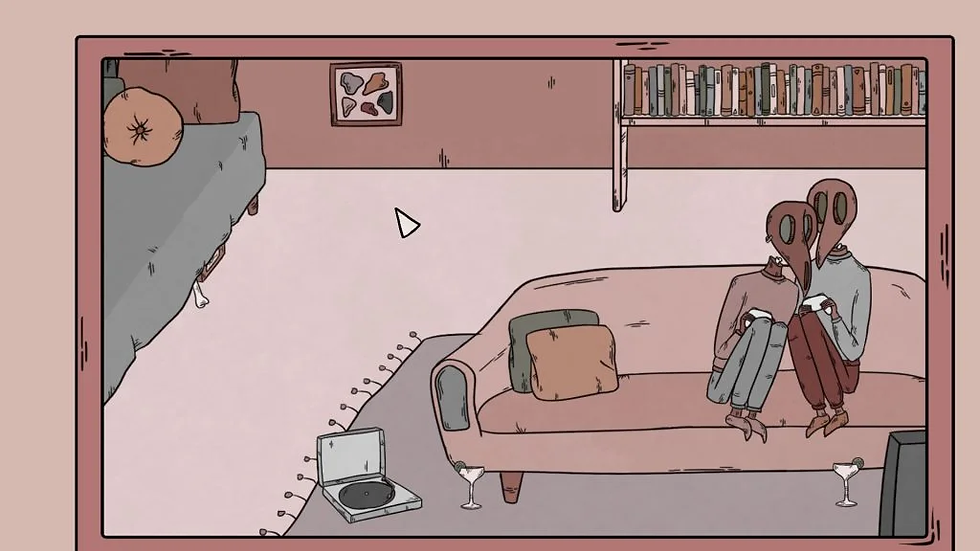
The ending feels earned because every small interaction leading up to it reinforced the same emotional idea. Mechanics, pacing, art direction, and narrative all point toward one central theme: Humans will create rituals, routines, and meaning just to feel connected. That thematic cohesion is what elevates Birth beyond being just a quirky indie puzzle game.
Design Lessons From Birth
1. Theme Should Influence Every System
The strongest part of Birth is its alignment. Everything supports loneliness and companionship:
The pacing
The art style
The music
The puzzle difficulty
The environmental storytelling
The progression loop
Nothing feels mechanically disconnected from the emotional goal.
2. Simplicity Can Be Powerful
The game proves that emotional depth does not require mechanical complexity. The interactions are small. The scope is small. The systems are simple. But because the experience is cohesive, it feels impactful.
3. Players Don’t Need Everything Explained
Modern games often over-communicate. Birth embraces ambiguity. That ambiguity allows players to emotionally participate in the narrative rather than simply consume it.
4. Tone Is Created Through Consistency
The reason Birth feels emotionally distinct is that every element reinforces the same atmosphere. Nothing breaks immersion. That consistency creates emotional trust between the player and the game.
Final Thoughts
Birth is one of the best examples of emotional cohesion in indie game design. It takes themes that could easily become grotesque or melodramatic and instead presents them with softness, empathy, and quiet honesty. The game understands something many narratives forget: Loneliness is not always dramatic. Sometimes it is simply sitting in a room by yourself, wishing another heartbeat existed beside yours.
By turning that feeling into mechanics, puzzles, atmosphere, and visual storytelling, Birth creates an experience that feels deeply human. And that is what makes it unforgettable.
You can check out the game here: https://store.steampowered.com/app/1889040/Birth/


Comments